Inclo
Bringing Accessibility and Transparency to Hiring
Inclo is a conceptual browser extension that supports more accessible hiring by enabling private, consent-driven sharing of accessibility needs between candidates and recruiters. Designed to integrate into existing recruiter workflows, it surfaces accessibility information only when it’s actionable—reducing risk for candidates and guesswork for recruiters.
Inclo At A Glance
Problem: Disabled and neurodivergent candidates lack safe ways to share accommodation needs; recruiters lack tools to support them.
Solution: A privacy-first browser extension + onboarding flow that integrates accessibility into existing hiring workflows.
My Role: Solo product designer (research → UX → UI → systems thinking)
Deliverables: Browser extension, Gmail assistant, job seeker onboarding, recruiter workflow
Status: Conceptual, research-backed
The Problem
Hiring disabled and neurodivergent talent is challenging for both job seekers and recruiters — but for different reasons.
Job seekers often need accommodations to succeed, yet mainstream job boards offer no private, structured way to share those needs. Candidates are forced to choose between disclosing sensitive information too early or navigating the hiring process without support. While inclusive hiring platforms exist, they typically offer a narrow set of roles and can reinforce limiting stereotypes about disabled talent.
Recruiters, on the other hand, lack tools to confidently identify and support disabled or neurodivergent candidates. Even when motivated to hire inclusively, they rely on assumptions or surface-level signals — approaches that feel unreliable, uncomfortable, and ineffective.
Design Framing
Balancing Accessibility, Privacy, and Real-World Workflows
Designing a more accessible hiring tool meant balancing the needs of two distinct user groups: disabled and neurodivergent job seekers, and recruiters working within fast-paced, existing sourcing workflows.
As an autistic designer, it was important to me that Inclo be shaped by lived experience rather than assumptions. I grounded the design in user research to understand where each group felt friction, risk, or uncertainty — and to ensure accessibility needs could be shared in ways that felt respectful, optional, and safe.
This framing guided every major product decision, from how information is disclosed to where the tool lives within a recruiter’s workflow.
Research
Accommodation Needs Are Universal
To understand what people actually need to succeed at work, I surveyed job seekers using accommodation data sourced from the Job Accommodation Network. Participants self-identified across disabled, neurodivergent, and non-disabled identities.
The results revealed a clear pattern: accommodation needs were largely shared across all groups.
This reframed accessibility as a universal design challenge — not a niche one. It directly informed Inclo’s positioning: a platform centered on disabled and neurodivergent users, but designed to benefit anyone navigating modern work environments.
Design impact: Accommodation options and language were built to be inclusive, flexible, and identity-optional — avoiding medicalized framing while supporting real needs.
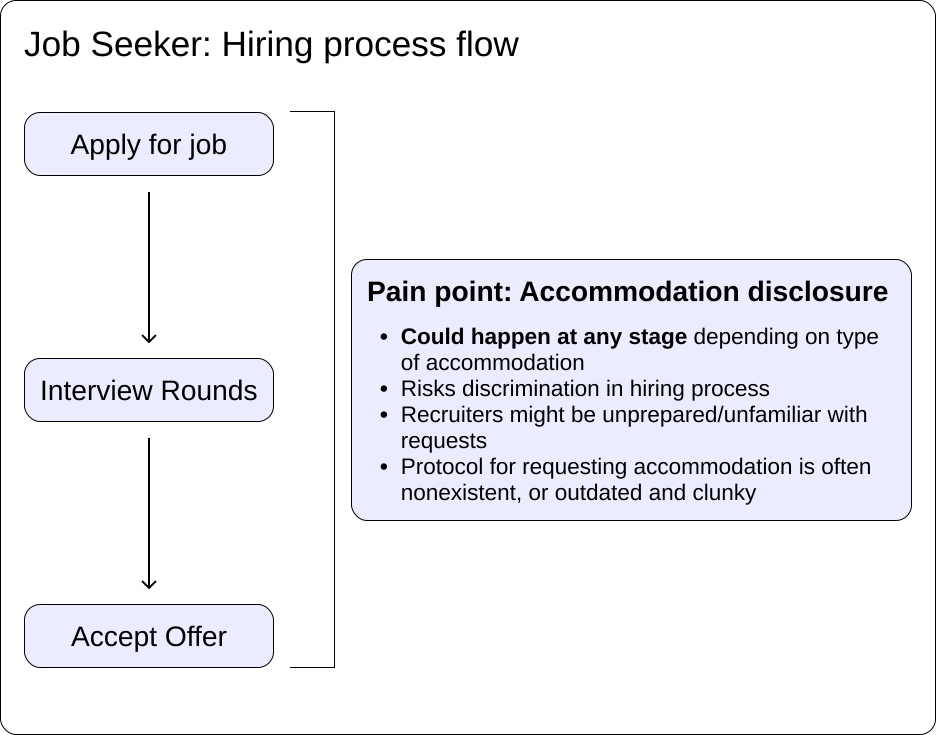
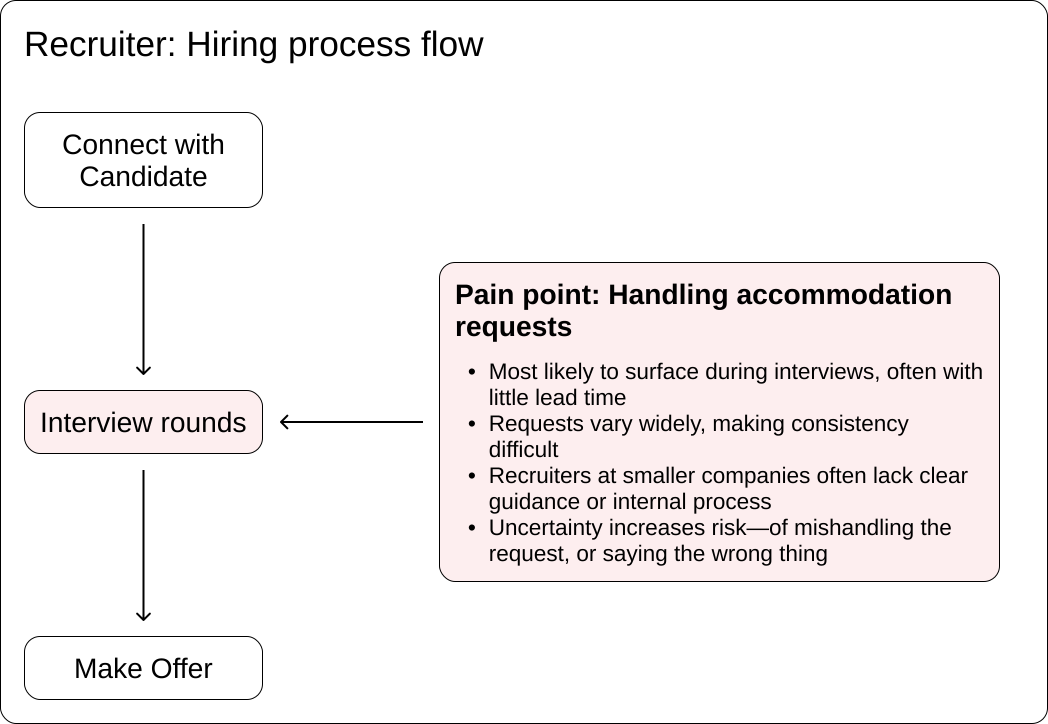
Accommodation disclosure creates risk and uncertainty for both candidates and recruiters across the hiring process.
Recruiters Want to Hire Inclusively — But Lack the Tools
To understand the recruiter side of the system, I interviewed a senior technical recruiter to map how diversity hiring actually works in practice.
Key insight: While recruiters are often incentivized to meet diversity goals, diversity hiring is rarely supported by real infrastructure. There are no practical tools for identifying, supporting, or sourcing diverse candidates—especially around disability and neurodiversity.
As a result, recruiters rely on: surface-level signals assumptions manual workarounds disconnected systems This creates friction for recruiters and risk for candidates.
Design impact: Inclo was positioned not as a “diversity initiative,” but as workflow infrastructure — embedding accessibility into tools recruiters already use.
Core Insights That Shaped the Product
Accessibility isn’t niche
Accommodation needs cut across identity groups — inclusive design benefits everyone.Recruiters lack infrastructure, not intent
The desire to hire inclusively exists, but tools don’t.Workflow compatibility is non-negotiable
Any solution must integrate into existing recruiting systems and browser-based workflows.Privacy and control are essential
Accessibility information must be shared voluntarily, selectively, and safely.
The Pivot
Initial Concept: A LinkedIn-Based Solution
My first approach positioned Inclo as a widget embedded directly into a job seeker’s LinkedIn profile, making accessibility and accommodation needs visible to recruiters within a platform they already used.
Early testing with 19 job seekers—both disabled and non-disabled—revealed a critical flaw in this assumption. Participants were deeply uncomfortable publicly displaying accommodation needs on LinkedIn, citing privacy concerns and fear of discrimination. While the concept improved recruiter visibility, it asked candidates to shoulder disproportionate risk.
This insight reframed the problem: the barrier wasn’t awareness, it was where and how accessibility information could be shared safely.
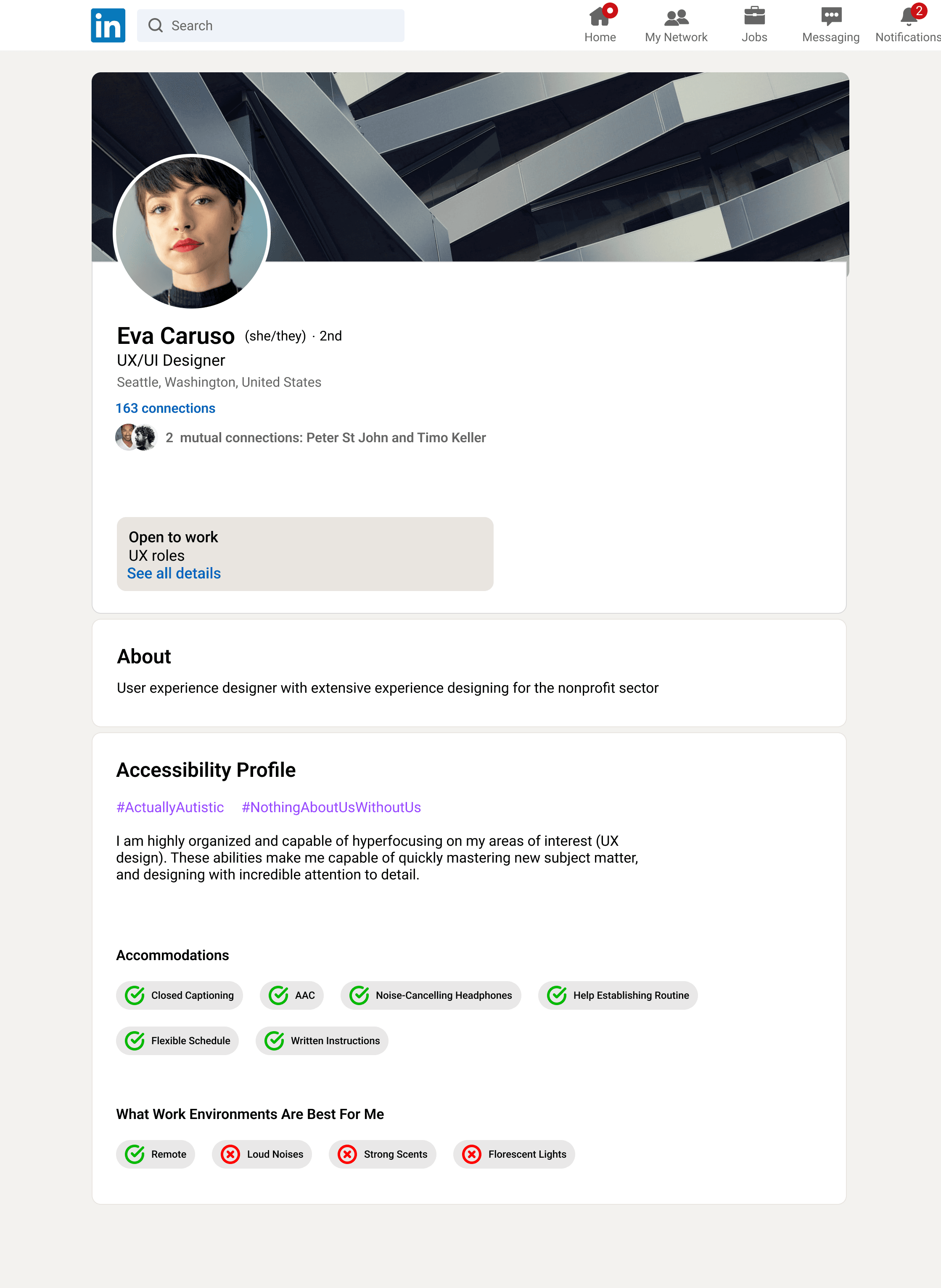
Early concept focused on embedding accessibility directly into LinkedIn profiles. Usability testing revealed privacy concerns and misalignment with how candidates manage disclosure.
Pivot: From Public Profiles to Recruiter Workflows
Follow-up research into recruiter workflows showed that recruiters already rely heavily on browser extensions layered on top of CRMs and job boards to collect and filter candidate data. Rather than embedding accessibility into a public social profile, Inclo could live inside these existing tools—allowing candidates to voluntarily self-identify in a private context, and recruiters to access accessibility needs only when relevant.
This led to a fundamental pivot: Inclo shifted from a LinkedIn integration to a browser extension. The new model respected candidate privacy while still enabling recruiters to proactively hire disabled and neurodiverse talent—removing guesswork without requiring public disclosure.
The Solution Ecosystem
Inclusive hiring is not a single-user problem—it exists within a complex ecosystem of candidates, recruiters, sourcing tools, CRMs, and organizational risk. Any solution that ignores this context risks either low adoption or unintended harm.
Inclo was designed to live inside this ecosystem, not replace it. By functioning as a browser extension layered onto existing recruiter workflows, Inclo integrates directly into the tools recruiters already use to source and evaluate candidates. This minimized behavior change while maximizing reach.
For candidates, Inclo provides control over when and how accessibility needs are disclosed—shifting disclosure from a public signal to a private, opt-in exchange. For recruiters, it reduces uncertainty by making accessibility considerations visible at the point of outreach, rather than after a breakdown in the interview process.
Importantly, Inclo does not attempt to be a standalone hiring platform or a public marker of diversity. Its role is intentionally narrow: to enable safer, more informed connections between candidates and recruiters within the systems that already exist.
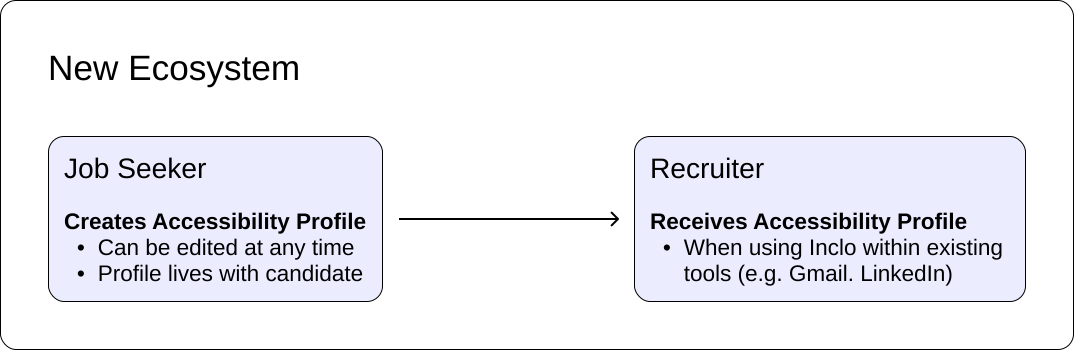
Inclo acts as a lightweight layer between candidates and recruiters, surfacing accessibility context only when it’s relevant.
Job Seeker Experience
The goal was not to help candidates “ask for accommodations,” but to help them communicate how they do their best work—without overexposing themselves in the process.
Designing for Agency in Disclosure
Early research made it clear that job seekers were not just sharing information—they were managing risk. Disclosure around disability and neurodivergence carries real emotional and professional consequences in hiring contexts where power is uneven.
Separating Identity from Support
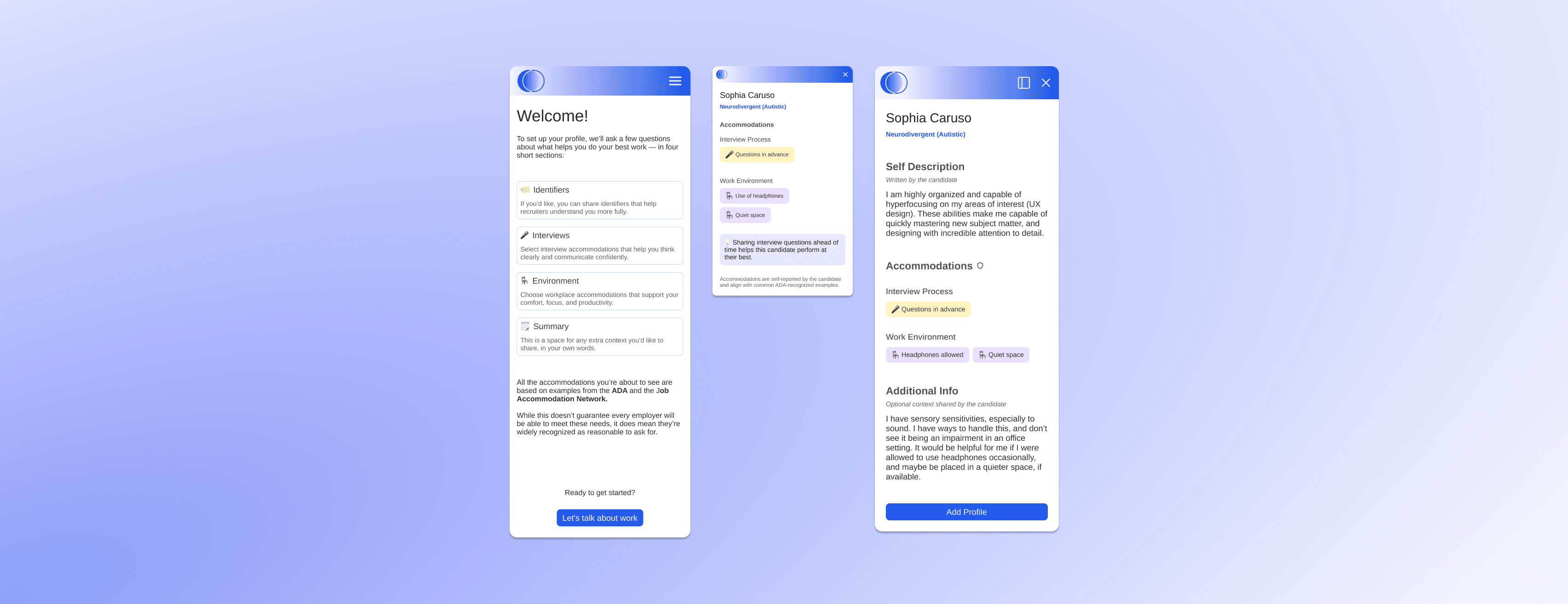
The onboarding flow begins with identifiers, but participation is optional and language-driven. Job seekers can self-describe using terminology that feels accurate to them—or skip the step entirely. This ensures that identity is never required to access accommodations.
This distinction was intentional: research showed that many candidates know what supports they need long before they feel safe naming why.
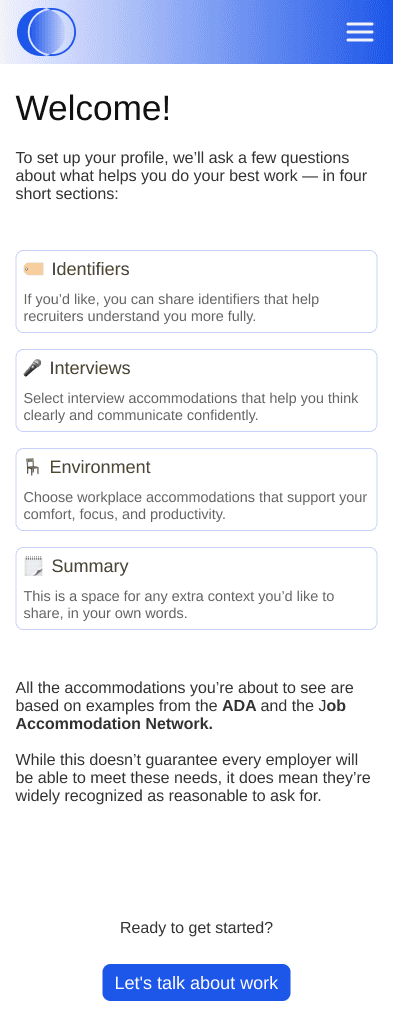
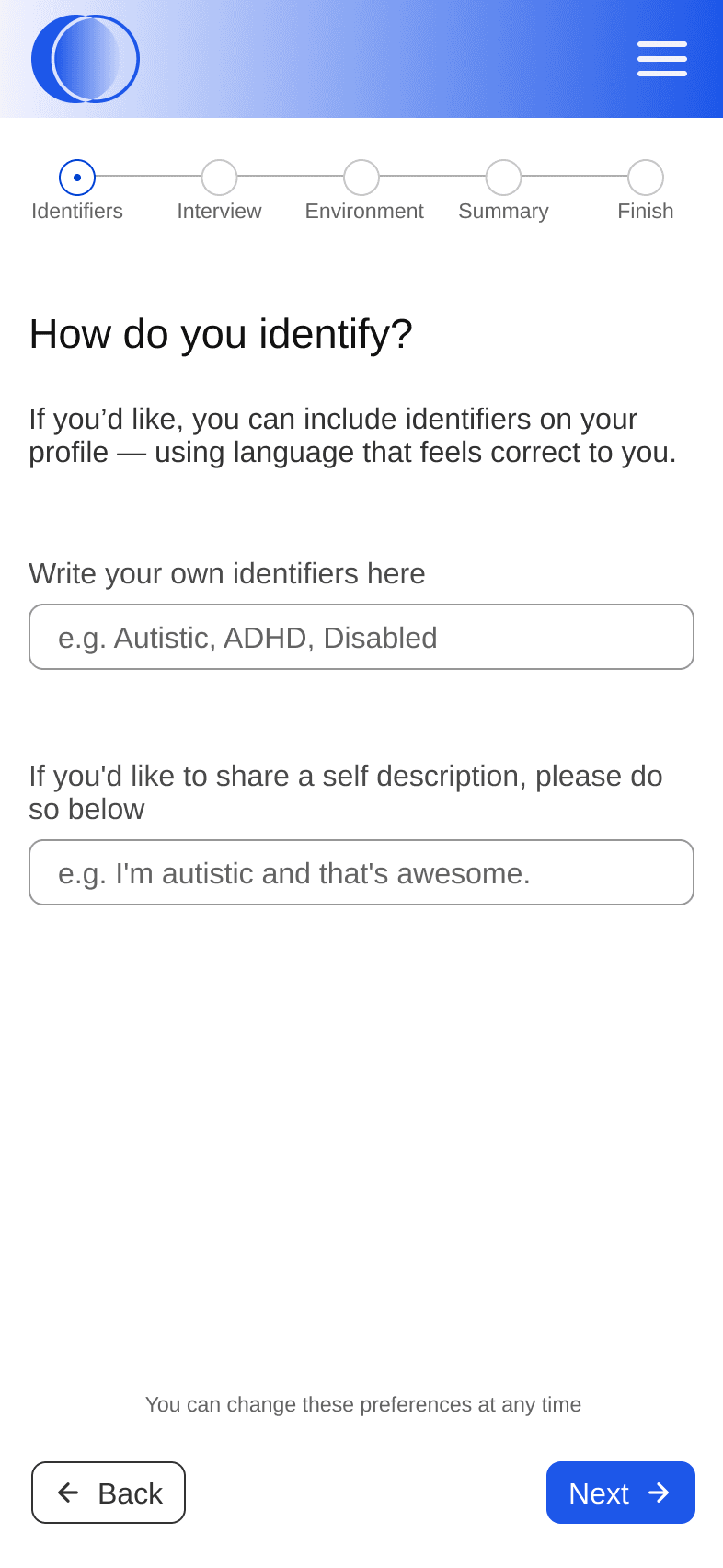
Identity is optional and language-driven, allowing candidates to self-describe—or skip disclosure entirely.
Contextualizing Needs by Situation
Instead of presenting a single list of accommodations, the flow breaks needs into situational contexts—interviews and work environments. This mirrors how candidates naturally think about support and reduces cognitive load, especially for users who may struggle to translate lived experience into formal requests.
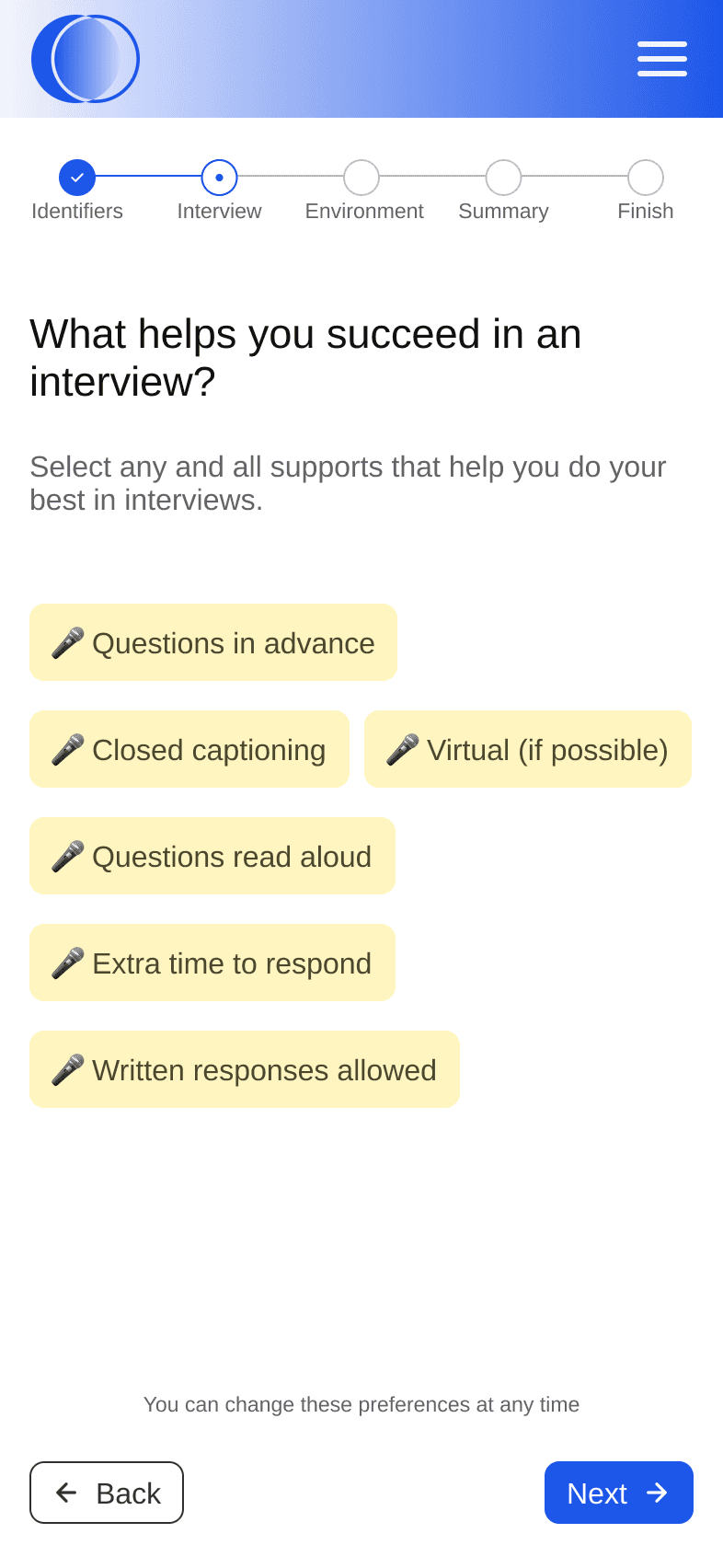
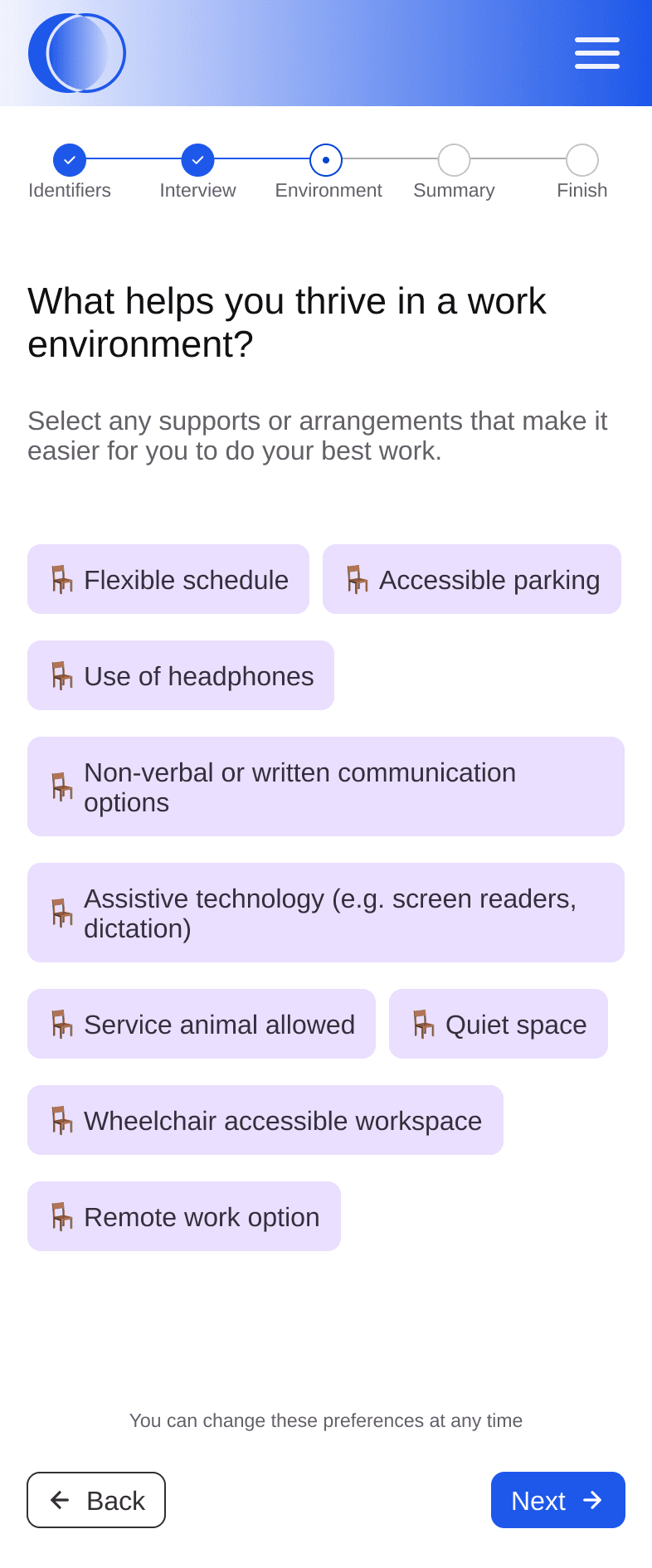
Accommodation needs are organized by context, mirroring how candidates naturally think about support.
Transparency Through Preview and Consent
Before completing onboarding, candidates are shown exactly how their profile will appear to recruiters. This summary view reinforces informed consent by making disclosure concrete, reviewable, and editable. Users retain control over their information and can update or revise it at any time.
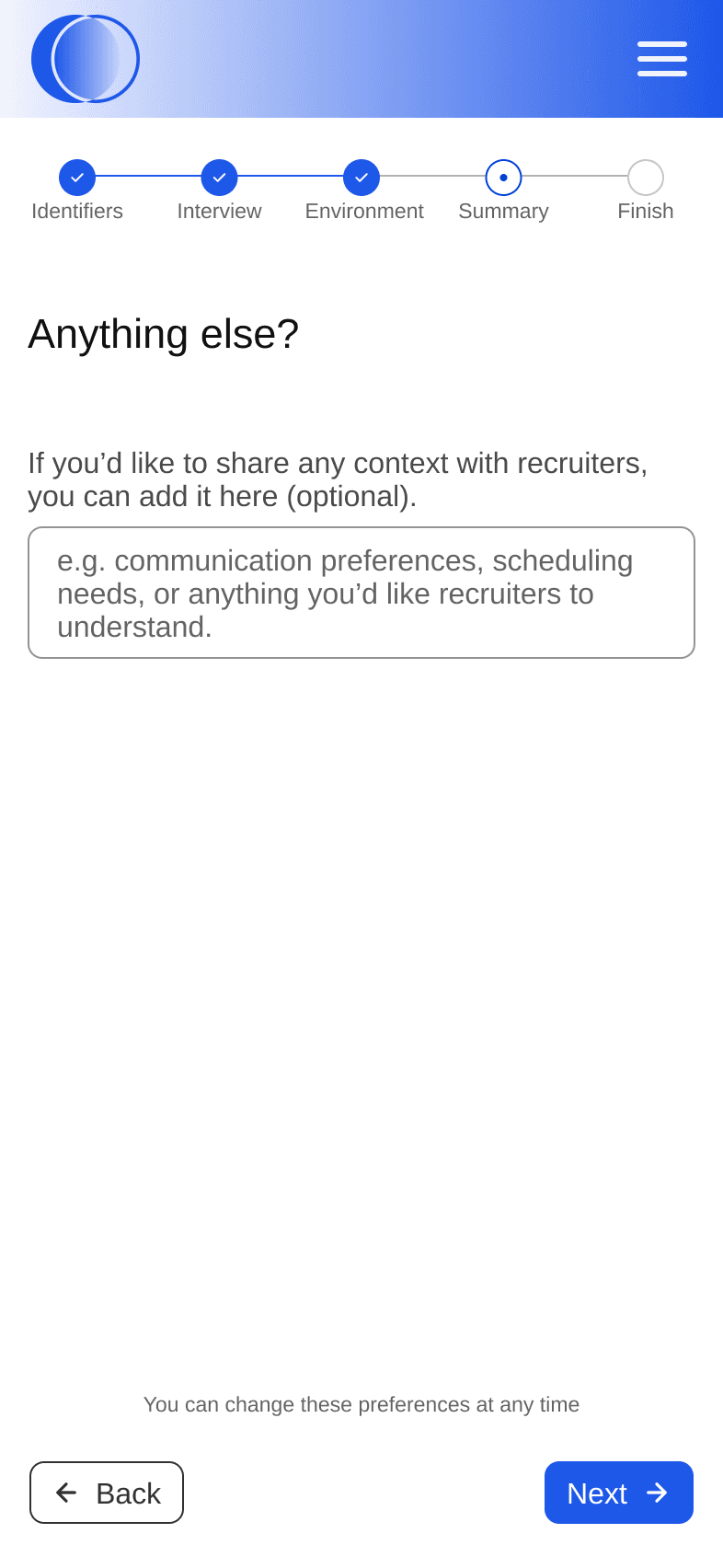
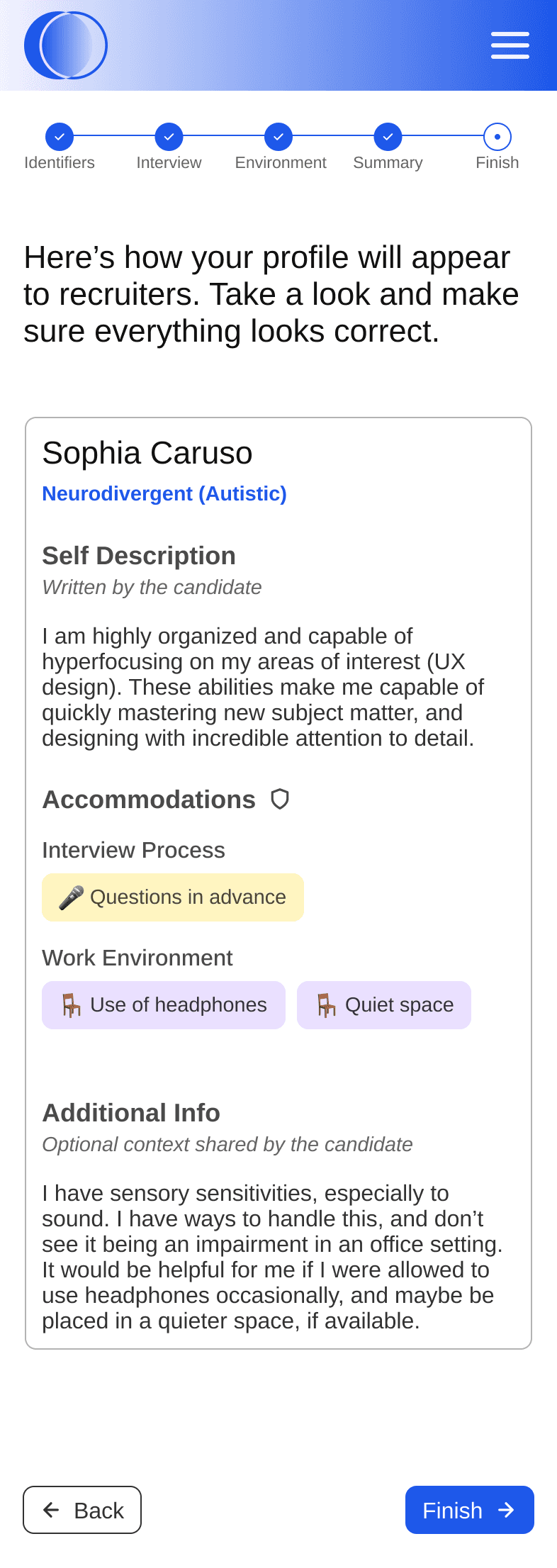
A preview reinforces informed consent by showing candidates exactly what recruiters will see.
Recruiter Experience
Inclo fits directly into existing recruiter workflows, surfacing accessibility information only after a candidate has already been identified—keeping inclusive practices aligned with how recruiting actually happens.
When a recruiter opens a candidate profile, Inclo provides access to the candidate’s accessibility profile within the same workflow. This candidate-authored context clarifies interview and workplace needs, reducing guesswork and supporting more prepared outreach and interviews

Recruiters encounter accessibility information only after selecting a candidate, keeping sourcing workflows unchanged.
Inclo does not interpret or rank candidates based on accessibility information. Its role is intentionally narrow: making relevant information available at the moment it can improve communication, without adding cognitive or legal risk for recruiters.

Accessibility context is available at the moment of outreach, helping recruiters prepare for inclusive communication without leaving their tools.
Outcomes & Reflection
Inclo demonstrated that inclusive hiring tools are most effective when they reduce risk asymmetrically borne by candidates and surface accessibility only when it’s actionable. Designing within existing recruiter workflows—and resisting feature creep—proved more impactful than building a standalone platform. This project reinforced my belief that accessibility is fundamentally about agency and power, not just access.